Is my land in the Green Belt, and what does that mean for selling it?
You have a plot, a paddock or a large garden, and somebody has told you it is "in the Green Belt". Usually that sentence is delivered as bad news. Sometimes it is. Often it is more complicated than that, and the difference is worth a great deal of money.
What the Green Belt actually is
The Green Belt is a planning designation, not a description of the land. It was drawn around the big cities from the 1950s onwards to stop them spreading. About one eighth of England sits inside one. The land inside is not protected because it is beautiful or ecologically important; it is protected because it is open, and national policy says openness is the point.
That matters because the test for building in the Green Belt is not "is this a nice field" but "is this development appropriate". National policy lists the things that count as appropriate: limited infilling in villages, replacing an existing building with one of a similar size, limited extensions, some agricultural buildings, and the reuse of buildings that are already there. Everything else is inappropriate by definition and needs "very special circumstances" to be approved, which in practice almost never happens for a single plot.
The first question: are you actually inside it
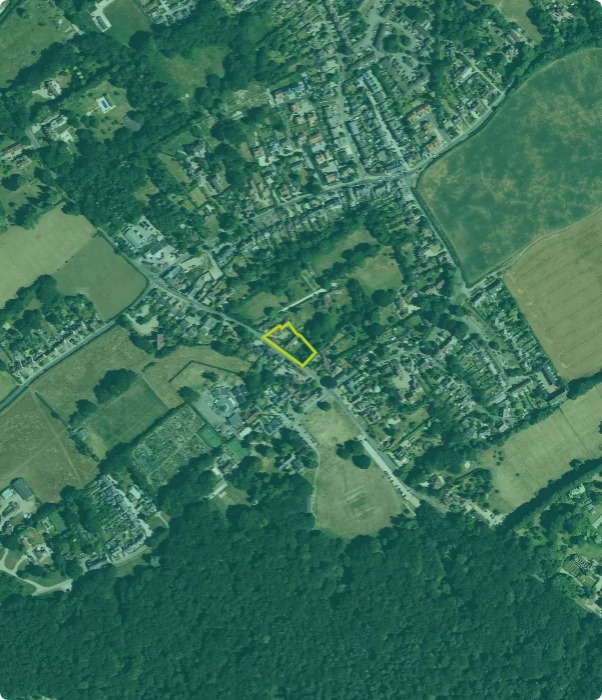
Green Belt boundaries are drawn by each council in its local plan, and they are precise. A village can be washed over by Green Belt or "inset" from it, meaning the settlement itself is excluded and only the land around it is protected. Two plots on the same lane can be on different sides of the line.
So before anyone forms a view about your land, check the boundary itself. The national planning data service publishes every council's Green Belt polygon, and our free assessment draws your actual boundary over it. A surprising number of people who have been told they are "in the Green Belt" turn out to own land inside an inset village boundary, where ordinary policies apply.
The second question: what is on the land now
If your plot has buildings on it, the picture changes. Previously developed land in the Green Belt can be redeveloped without harming openness, provided the new building is not materially larger than what stood there. A redundant barn, a yard, a run of old stables or a former workshop can carry more development value than an empty field next to it, precisely because something already exists.
Recent changes to national policy added the idea of "grey belt": Green Belt land that makes only a weak contribution to the purposes the Green Belt is meant to serve. Councils are now expected to look at grey belt land first when they need housing sites. Whether your plot qualifies depends on a judgement about how it relates to the countryside and the town, and it is a judgement worth having made properly rather than guessed at.
The third question: what the council needs
Green Belt release happens through local plans, not through individual applications. If your council cannot show enough housing land, it is under pressure to review its Green Belt boundaries, and land next to existing settlements with good access is what gets looked at. That is a slow route, measured in years, but for the right plot it is the route that turns agricultural value into development value.
If the council has plenty of housing land, there is no pressure, and no plot on its own will change that.
What this means for a sale
Developers price Green Belt land in one of three ways. Land with no realistic route to permission is priced as agricultural or amenity land. Land with buildings on it, or land inside an inset boundary, is priced on what could replace what is there. Land that a local plan review might release is bought on an option or a promotion agreement, where the developer pays a small sum now and a large one only if permission follows.
Knowing which of those three you are holding, before you speak to anyone, is the whole game. An option agreement on land that could have been sold outright leaves money on the table; an outright sale of land that a plan review is about to release leaves far more.
If houses are off the table, the land is not worthless
Green Belt policy is about new building in the open countryside. It says very little about how land is used, and a plot that will never take houses can still carry real value for someone whose plans do not need them.
- Equestrian use. Stables, a manege and grazing are among the most common Green Belt approvals in the country. Land near a town with road access and water is worth more to a livery yard than to a farmer.
- Glamping, camping and ecotourism. Small-scale tourist accommodation on rural land is regularly supported where it is low-key and well screened. Councils that would refuse three bungalows will often accept six shepherd's huts and a shower block.
- Reusing what stands there. Redundant barns and stables can be converted to offices, workshops, studios, farm shops or community uses, and agricultural buildings have a dedicated national permission route for conversion to homes in some cases. The building already exists, so openness is not harmed.
- Renewable energy. Ground-mounted solar and battery storage are approved in the Green Belt where the harm to openness is outweighed by the benefit, and operators pay long index-linked rents.
- Nature and offsetting. Biodiversity net gain means developers elsewhere must pay for habitat creation. A landowner who can offer a thirty-year habitat bank on unproductive Green Belt land has a buyer that did not exist five years ago.
Different buyers pay for different uses. A housebuilder is one possible bidder for a piece of land, not the only one, and on Green Belt land they are usually the least likely to succeed. Part of a proper assessment is working out which use the site could realistically take and who pays for that use. We will cover the alternatives in detail in a separate article.
A straight answer for your plot
Our free assessment draws your boundary against the Green Belt polygon, checks whether your settlement is washed over or inset, looks at what already stands on the land, and reads the council's current housing position. You get a written answer from an architect within 48 hours saying which of the three positions you are in and what that means for value. If houses are not realistic, we say so, and we say what else the land could do.
Own land somewhere in particular? The Land by postcode pages show recent sales, planning designations and the deciding council for each district.
More articles
Can I Apply for Planning Permission on Land I Don't Own?
Yes. Anyone can apply for planning permission on land they don't own, but they must notify the owner using the correct ownership certificate.
How Much Is CIL on a New Home in London?
It depends on your borough and zone, and is charged per square metre on top of the Mayor's London-wide rate. Self-builders can often claim an exemption.
Airspace Development: Can I Build on Top of My Building?
Often yes, under permitted development rules that allow extra storeys on houses and blocks of flats, subject to prior approval and strict conditions.
Check your land for free
Find out which constraints affect your property and what your options are. Takes two minutes.
Check my land →