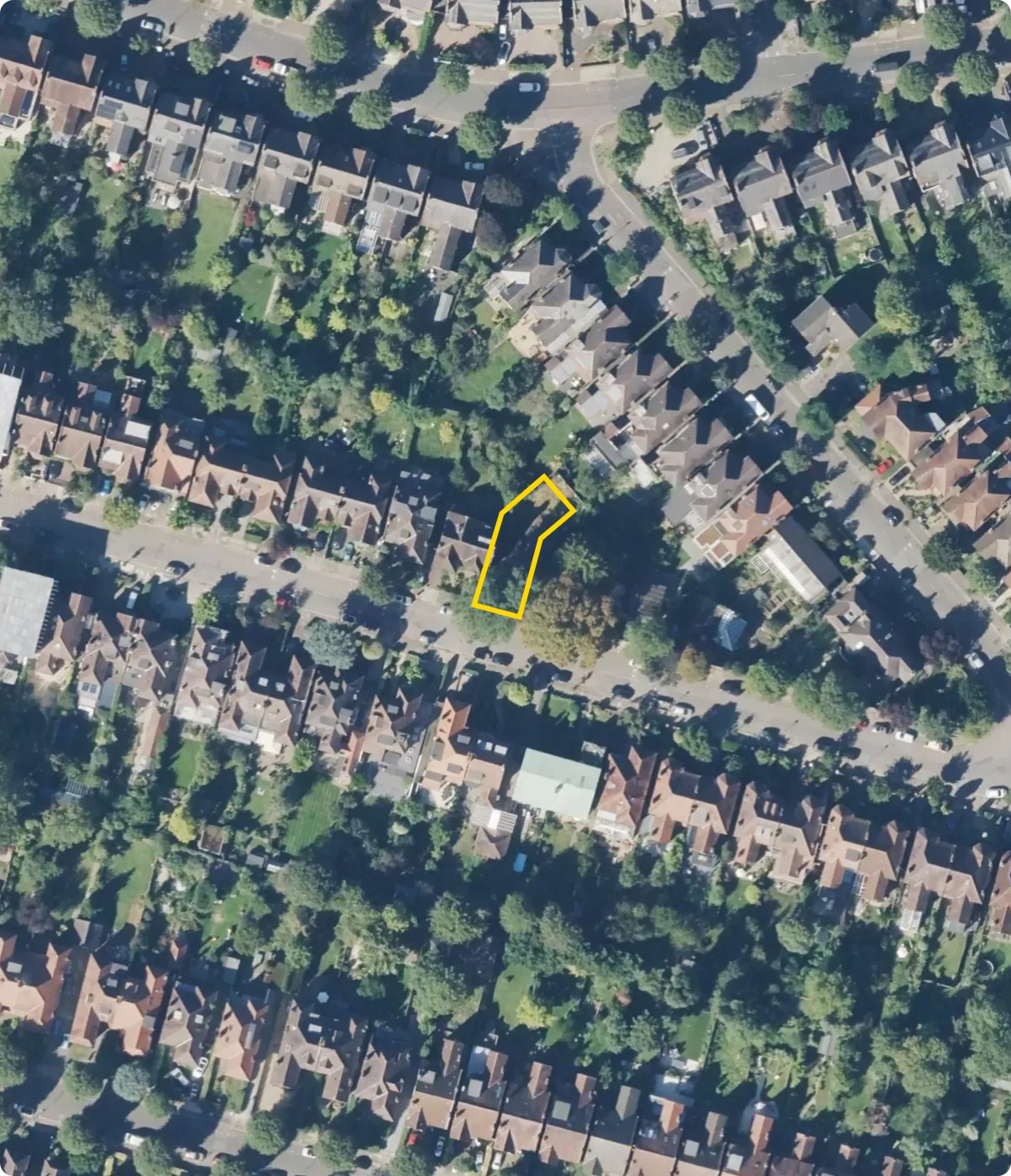
Can my land in London be developed? What 9,756 small-scheme decisions since 2021 say
Every week someone in London asks us a version of the same question. There is a wide side garden, a run of garages, an old workshop, a plot behind the house. Could it take a home or two? The honest answer used to be "it depends on the borough", said with a shrug. We can now say what it depends on, because we have read the decisions.
What we counted
Since January 2021, London's councils have decided 11,369 planning applications in which the applicant's own planning form declared between one and nine net new homes. That is the landowner scale: not tower blocks or estate regeneration, but the garden plot, the backland site, the shop with flats above, the bungalow replaced by three houses. We took the number of homes from the residential units table on the planning form itself, so it is what the applicant said they would create, not our reading of the description, and we joined every application to the council's decision by its reference.
Of those 11,369 applications, 5,482 were approved: 48 per cent.
So the first answer is yes. Small schemes get permission in London roughly half the time. The second answer is that "roughly half" hides a wide spread depending on which borough you are standing in.
Where it works
Among boroughs with at least 100 small-scheme decisions in the period, the highest approval rates are Merton at 71 per cent (282 of 399), Westminster at 65 per cent (275 of 422), Camden at 62 per cent (116 of 186), and Ealing and Enfield at 59 per cent each. Ealing is the busiest borough for small schemes by some distance, with 1,390 decisions and 824 approvals.
Where it does not
At the other end, Havering and Croydon both approved 30 per cent of small schemes: 42 of 139 in Havering, 207 of 690 in Croydon. Lambeth approved 34 per cent, Harrow and Barking and Dagenham 37 per cent, Kingston 38 per cent.
A low figure does not mean nothing is possible; it means the bar is high and the scheme has to be right. The next question is what makes it right, and that is where the type of plot matters.
The garden plot specifically
Garden and backland plots are the hardest sub-category, and the one most landowners ask about. Where the proposal was explicitly for a new home on a garden, backland or infill plot, London's councils decided 444 applications in the period and approved 172: 39 per cent, noticeably below the 48 per cent for small schemes as a whole.
Lewisham decided the most of these, 86, and approved 39. Croydon decided 69 and approved 24. Greenwich decided 37 and approved 15. Barking and Dagenham decided 39 and approved 7. Havering decided 19 and approved 2.
In the schemes we have assessed, the approved ones tend to share a pattern: a plot with its own access to the road, a design that sits lower or smaller than the neighbours, and enough distance to the nearest windows to avoid an overlooking argument. The refused ones are usually the mirror image: access over someone else's drive, a house squeezed against a boundary, or a garden the council's policy treats as open space worth keeping.
How long it takes
Across London the median time from a valid application to a decision on a small scheme is 92 days, about 13 weeks. The statutory target is 8 weeks, so the typical application runs past it. Add the design and pre-application stage in front and a garden-plot permission is realistically most of a year from first sketch to decision notice. We look at how this varies by borough in how long planning takes in London.
What this means for your land
If your plot is in London, the question is not whether the borough allows small schemes but what your borough approved and refused on plots like yours. Every London postcode district page on this site shows the figures for that district: how many applications were for building on land like yours, how many were approved, how long they took, and named examples of what got through, alongside the sales evidence and planning designations for the area.
If you want it read against your actual boundary rather than the district, the free check does that, and the Land Value and Options Report sets out the routes for your plot (sell now, an option agreement, or running planning yourself) for £95, refunded if it does not give you a clear answer.
Figures: decided planning applications since 1 January 2021 in 29 of the 33 London boroughs' own registers, joined to the applicant's planning form; counts, not estimates. Tower Hamlets, Newham, Wandsworth and Haringey are not yet in our data, so none of the figures above include them.
Own land somewhere in particular? The Land by postcode pages show recent sales, planning designations and the deciding council for each district.
More articles
Can You Sell Part of Your Garden? Here's What's Actually Involved
Selling off a slice of your garden for someone else to build on sounds simple, but it touches your title deeds, your mortgage, your access, and your neighbours. Here's what to check before you put a for-sale sign on the flower bed.
Is my land in the Green Belt, and what does that mean for selling it?
Green Belt is a boundary, not a verdict. The three questions that decide whether a Green Belt plot has development value, and how developers price each answer.
What a developer will actually pay for your land: the residual method in plain English
Every housebuilder prices land the same way. Here is the method, why offers for the same plot differ, and how to check a number in ten minutes.
Check your land for free
Find out which constraints affect your property and what your options are. Takes two minutes.
Check my land →